Sell to GTR
Sell Surplus Network Equipment
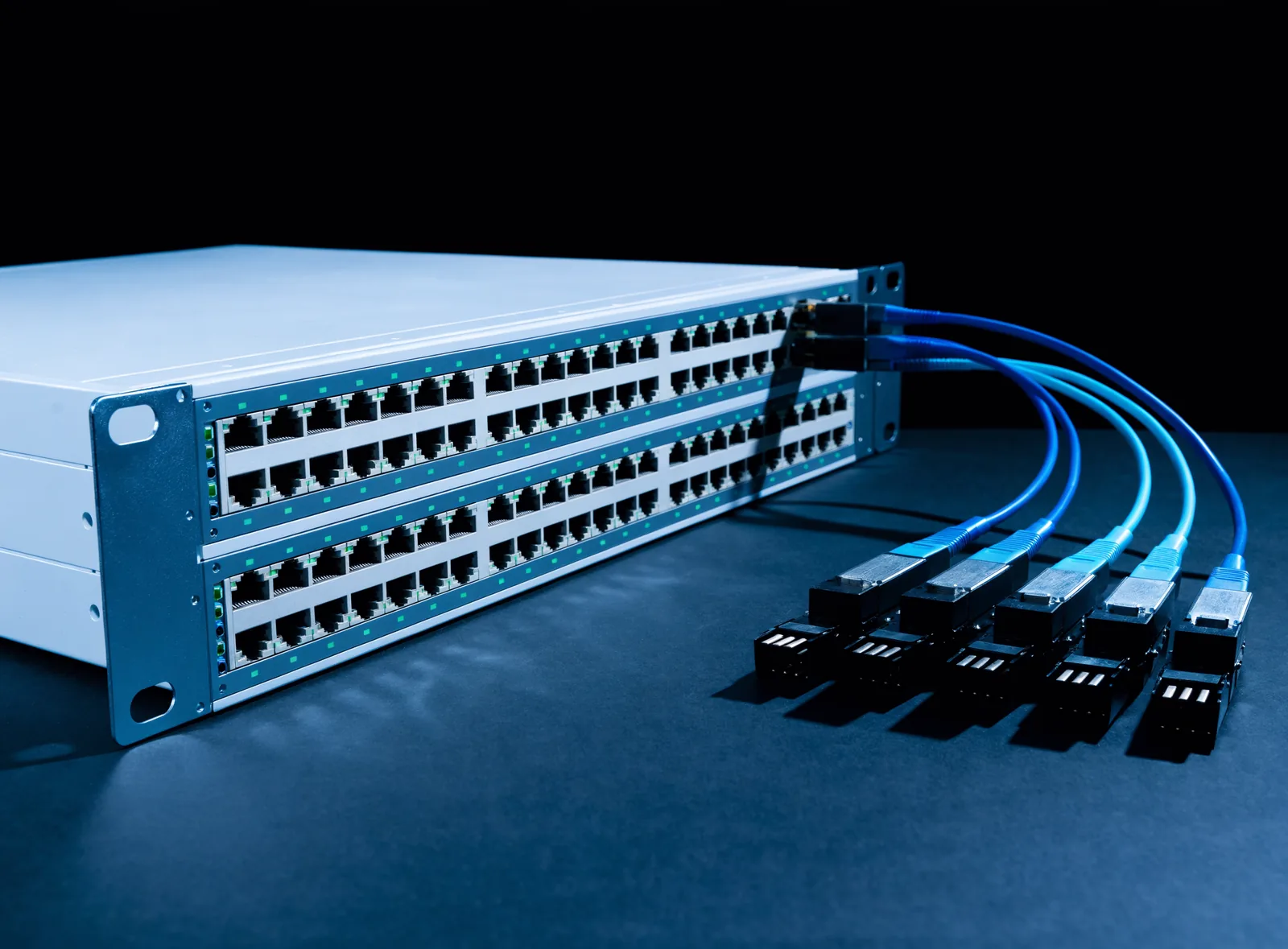
GTR Supply buys surplus network equipment in bulk: rackmount switches from access to aggregation, network interface cards, optical transceivers, direct attach cabling and the rack infrastructure that goes with them. Two things are worth saying at the top, because they are the two reasons sellers write this equipment off before asking. First, we buy switches whose licences cannot transfer to a new owner. A licence that dies with the previous owner changes what a switch is worth, but it does not make the hardware worth nothing, and plenty of buyers relicense at their end. Second, we buy loose transceivers on their own. Optics do not need a switch attached to them to be worth listing, and a box of assorted modules that has been sitting in a comms room is a normal lot for us rather than an awkward one.
What we take
Networking we buy.
- Rackmount access, aggregation and core switches
- Switches whose licences cannot transfer to a new owner
- Optical transceivers, in bulk or as a loose assorted box
- Network interface cards and host bus adapters
- Direct attach copper and active optical cables
- Redundant power supplies, fan modules and rack rails
- Patch panels, PDUs and rack infrastructure alongside the active kit
Buying rather than clearing? See the Networking we supply by the lot.
What your list needs
Write these down.
- Switch model, exactly as printed on the chassis rather than the family name
- Port count and port speed, and the uplink speed if it differs
- Power supply count, and whether both supplies are present on redundant units
- Transceiver part numbers and the quantity against each
- What licence state the switches are in, as far as you know it
- Whether rails, brackets and blanking plates are included
- Whether the units are still racked and cabled or already pulled
Missing some of it?
Send it anyway and write unknown against the gaps. An honest gap is easy to price around. A wrong specification found at collection is what forces a valuation to be revised.
Not certain what is on the pallet? See the 10 families of Networking that circulate on the secondary market and how to tell them apart, each with the part number prefix or the physical marker that identifies it. That page is identification help for writing this list rather than a stock list.
Identify what you have
Most of what a valuation needs is a model number read correctly. The catch with Networking is that the number sits in a different place on every manufacturer's hardware, and reads differently once you have found it. These pages show where it physically is, how to read each field in it, and what the fields mean. They are identification help rather than stock lists. If typing the list is not realistic, a photograph of the right label is usually enough.
Every brand GTR Supply buys and sells, grouped by category, with the identification detail for each one.
What moves the number
Up, and down.
Condition is only part of it. Most of what decides a valuation is how the lot is put together and how accurately it is described, and both of those are still in your hands when you write the list.
Moves it up
- A batch of identical switches rather than one of each model
- Both power supplies and all fan modules present
- Transceivers listed by part number with counts, rather than as a mixed box
- Rails and mounting brackets included
- Higher port speeds, which have a broader set of buyers than legacy access switches
Moves it down
- Missing power supplies or fan modules, which have to be found before a switch is usable
- Legacy access switches at low port speeds, which move slowly whatever their condition
- Broken port latches, bent chassis ears or damaged fibre connectors
- A switch described by family name with no model number, so port speed cannot be confirmed
- Optics with the labels rubbed off, since the part number cannot then be read
Free valuation
Get a number on your Networking.
No obligation. Send what you have and we will tell you what it is worth and how quickly we can move it.
Clearing more than one category? See everything GTR Supply buys. Mixed lots are normal, and the whole room is usually worth more than the parts of it offered separately.
Purchasing desk
Daniel Maxwell
Procurement Specialist
Evan Parker
Sourcing Specialist
Common questions
Selling Networking, answered.
My switch licences will not transfer. Is the switch still worth anything?
Yes. GTR Supply buys switches whose licences cannot transfer to a new owner, and this is worth knowing because it is the single most common reason a seller decides not to bother asking.
On many platforms features are unlocked by a licence tied to the original purchaser, and when the switch is sold the entitlement stays behind. The hardware is unaffected. What changes is that the buyer starts from the base feature set and has to relicense at their end if they want more, which many are perfectly willing to do.
So the licence state changes the number rather than removing it. That is why we ask for it up front, alongside the model and the port count.
Write down whatever you know, even if it is only that the licences were bought under a contract you cannot pass on. An honest note beats leaving the field blank and beats writing the switch off entirely.
Do you buy transceivers on their own?
Yes. GTR Supply buys loose transceivers without a switch attached, including the box of assorted modules that accumulates in every comms room over a decade.
List them by part number with a count against each. Optics carry a small identifier chip coded to a switch vendor, and many switches check it before bringing a port up, so the coding is what decides which buyers a module suits. Two optics that are identical in speed, reach and connector can be very different items if they are coded to different platforms.
The part number is printed on the metal body, usually along the side or on the pull tab. It is small, so photograph rather than transcribe if the box is large.
Mixed boxes are fine. If sorting a hundred assorted modules is not a good use of your afternoon, photograph a sample, give us a rough count and send it as one line.
What do you need to know about a switch to value it?
The model exactly as printed on the chassis, the port count, the port speed, how many power supplies are fitted, and the licence state as far as you know it. Those five fields do almost all the work.
The model number matters more than the family name. Manufacturers sell a long run of models under one family name across many years and several port speeds, so the family name alone does not tell us whether a unit is a modern aggregation switch or a legacy access switch.
Power supplies are the field most often left off. Redundant units shipped with two, and one that arrives with a single supply needs the other found before it can be deployed.
Add whether the rails are included and whether the units are still racked. GTR Supply can work from a photograph of the front and rear of one unit plus a count if writing it out is quicker that way.
Do I need to wipe the switch configuration before it leaves?
You are welcome to, and many organisations require it as policy, but it is not something you have to arrange before contacting us. Every switch and router is reset to factory defaults before it goes anywhere from here.
It is worth understanding what is on the box either way. A configured switch can hold VLAN layouts, routing detail, SNMP strings, access control lists, saved certificates, stored logs and management credentials belonging to your organisation. That is your exposure while the unit is still in your building, which is the argument for clearing it at your end regardless of what happens afterwards.
If your policy requires the reset to be witnessed or recorded, say so on the list so it is built into how the collection is arranged rather than raised on the day.
And tell us if a unit needs to stay on a particular firmware level, because that is easier to preserve if it is known in advance.
Guides
Clearing Networking is mostly a description exercise. These cover what a buyer is actually pricing and what the words on a quote mean before you agree to any of them.



Clearing more than one category?
Most decommissions are mixed. Send the whole list and we will value it as one lot rather than making you split it up first.
Prefer WhatsApp? Message us on (945) 397-7765